If you’ve ever wondered whether to write while or whilst, you’re not alone. These two words have nearly the same meaning, yet they don’t always sound equally natural.
Some writers use whilst to give their writing a more formal or traditional tone, while others prefer while because it’s simpler and more common.
The confusion often comes from regional differences, writing style, and personal preference. You may see whilst in British novels, academic writing, or legal documents, while while dominates American English and most modern business communication.
Knowing when each word fits best can make your writing sound more natural and appropriate for your audience.
In this guide, you’ll learn the difference between while vs whilst, how native speakers use them, their grammar rules, regional preferences, style guide recommendations, and plenty of real-life examples to help you choose the right word with confidence.
Quick Answer
Both while and whilst are grammatically correct and usually have the same meaning.
- While is the preferred choice in American English and is also the most common word in modern British English.
- Whilst is mainly used in British English, where it sounds more formal, traditional, or literary.
- If you’re writing for an international audience, while is usually the safer and more natural option.
Quick recommendation: Choose while for most writing. Use whilst only if you’re intentionally writing in a traditional or British style.
While vs Whilst Comparison Table
| Feature | While | Whilst |
|---|---|---|
| Meaning | During the same time; although | During the same time; although |
| Part of Speech | Conjunction, noun | Conjunction |
| Pronunciation | /waɪl/ | /waɪlst/ |
| Meaning Difference | None in most contexts | Same as while |
| Grammar | Fully correct | Fully correct |
| Formality | Neutral | Slightly more formal or traditional |
| American English | Standard and preferred | Rare |
| British English | Very common | Correct but less common than while |
| Academic Writing | Widely accepted | Acceptable in British publications |
| Business Writing | Preferred | Less common |
| Everyday Conversation | Very common | Less common |
| Legal Writing | Common | Sometimes preferred in UK legal documents |
| Sounds Natural To | Global audience | Mostly British readers |
| Modern Usage | Highly preferred | More traditional |
| Best Choice | Most situations | Formal British style |
What Does While Mean?
Definition of While
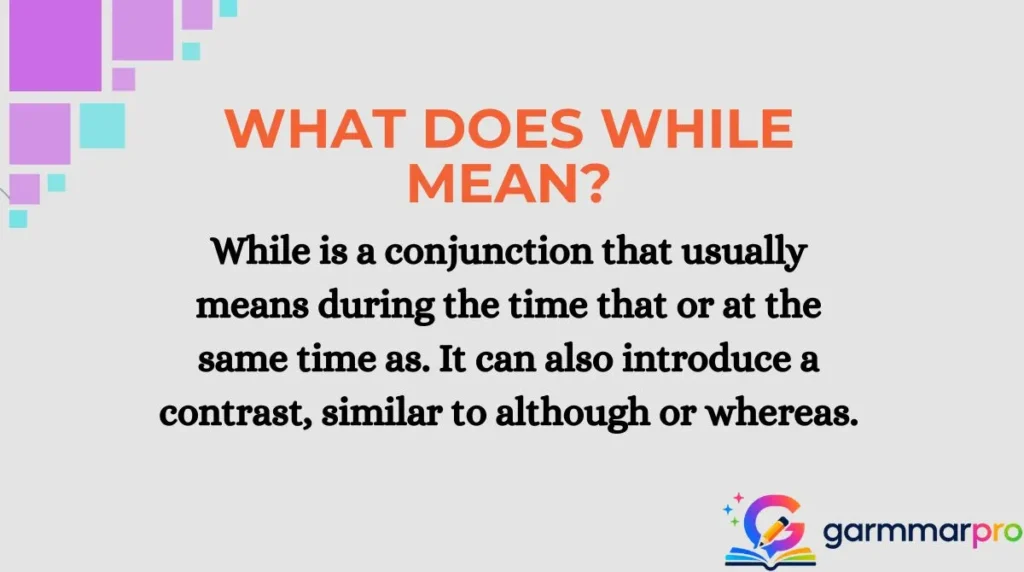
While is a conjunction that usually means during the time that or at the same time as. It can also introduce a contrast, similar to although or whereas.
It is one of the most frequently used words in English and appears in everyday conversations, books, newspapers, business emails, academic papers, and online content.
Origin of While
The word while comes from Old English hwīl, meaning a period of time. Over centuries, it developed into both a noun and a conjunction and became the standard form across English-speaking countries.
Today, while is considered the default choice in modern English.
Grammar of While
While functions as:
- A conjunction
- A noun
As a conjunction, it connects two clauses.
Example:
She listened to music while studying.
It can also show contrast.
Example:
While I understand your opinion, I disagree with your conclusion.
As a noun, it refers to a period of time.
Example:
It has been a while since we last met.
Pronunciation
While
IPA: /waɪl/
It rhymes with:
- mile
- file
- smile
When to Use While
Use while when talking about:
Two actions happening at the same time
She cooked dinner while her children finished their homework.
A contrast between ideas
While the project was expensive, it was successful.
A period of time
Please wait a while.
Everyday speaking
Native speakers naturally choose while in conversation.
Professional Writing
Business professionals almost always use while because it sounds clear and modern.
Example:
Please review the report while I prepare the presentation.
Academic Writing
Most universities accept while without hesitation.
Example:
While previous studies focused on adults, this research examines teenagers.
Everyday Conversation
You’ll hear sentences like:
- I’ll call you while I’m driving home.
- Can you watch the kids while I cook?
- She smiled while reading the message.
- Don’t talk while chewing.
Examples Using While
- She answered emails while waiting for her flight.
- I listened carefully while the teacher explained the lesson.
- He worked while everyone else relaxed.
- Please stay here while I check the schedule.
- They laughed while watching the movie.
- I’ll finish the report while you prepare the slides.
- While I appreciate your help, I prefer another solution.
- She learned Spanish while living in Madrid.
- He called me while I was having dinner.
- We talked for a while before leaving.
Common Mistakes with While
Using “while” when “although” sounds clearer
Less natural:
While it was raining, we still enjoyed the picnic.
Better:
Although it was raining, we still enjoyed the picnic.
Both are grammatically correct, but although sometimes expresses contrast more clearly.
Confusing the noun and conjunction
Correct:
We waited a while.
Correct:
We waited while the manager finished the meeting.
The first refers to a period of time. The second connects two actions.
Tips for Using While Naturally
- Choose while for international readers.
- Use it in business, academic, and online writing.
- Prefer it in emails and professional communication.
- It’s the safest choice if you’re unsure which word to use.
What Does Whilst Mean?
Definition of Whilst
Whilst is a conjunction that has virtually the same meaning as while. It means during the time that, at the same time as, or sometimes although.
Unlike while, whilst is mostly associated with British English and often gives writing a slightly more formal, literary, or old-fashioned tone.
Importantly, whilst is not more grammatically correct than while. The two words are interchangeable in most contexts, but they differ in style and regional preference.
Origin of Whilst
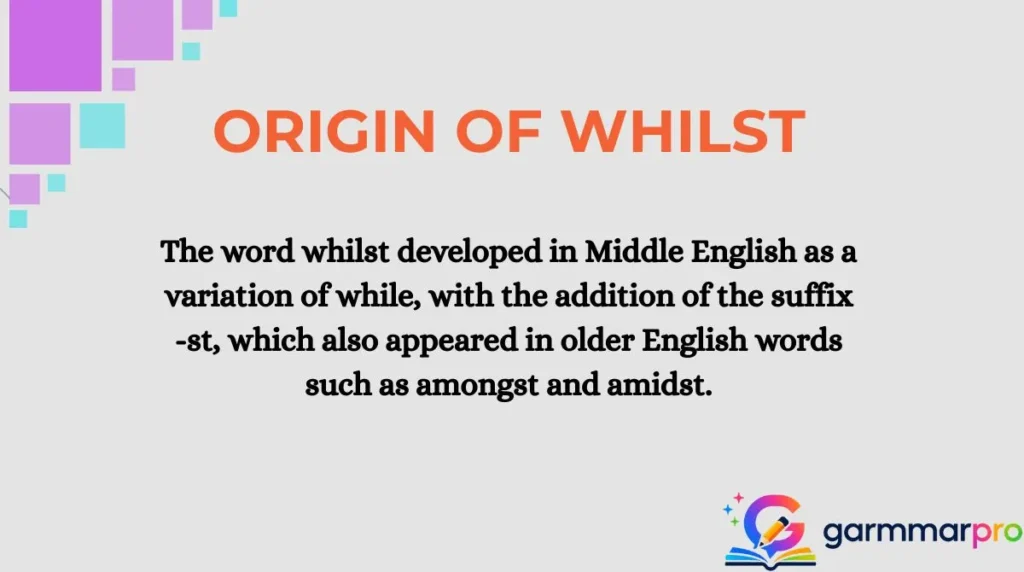
The word whilst developed in Middle English as a variation of while, with the addition of the suffix -st, which also appeared in older English words such as amongst and amidst.
Over time, while became the dominant form in most English-speaking countries, while whilst remained in use mainly in Britain and some Commonwealth nations.
Grammar of Whilst
Like while, whilst functions as a conjunction.
Examples:
- She read a novel whilst waiting for the train.
- He listened carefully whilst taking notes.
- Whilst I understand your concern, I believe another solution is better.
There is no grammatical difference between while and whilst. The choice is based on style, audience, and regional usage—not grammar.
Pronunciation
Whilst
IPA: /waɪlst/
The final “st” sound distinguishes it from while and gives it a slightly more traditional rhythm in speech.
When to Use Whilst
Use whilst when:
- Writing primarily for a British audience.
- Adopting a formal or literary tone.
- Following an organization’s preferred style in the UK.
- Writing historical, legal, or traditional content where whilst sounds natural.
Avoid using whilst simply because it seems more sophisticated. In many contexts, especially outside the UK, it can sound unnecessarily formal or dated.
What Does Whilst Mean? (Continued)
Professional Use
In the United Kingdom, whilst sometimes appears in:
- Legal documents
- Government publications
- Academic papers
- Policy documents
- Traditional business correspondence
Examples:
- Applicants must remain seated whilst the examination is in progress.
- Employees should wear protective equipment whilst operating machinery.
- Please retain this document whilst your application is being processed.
Although these examples are perfectly correct, many organizations now prefer while because it is shorter and more familiar to international readers.
Academic Use
British universities generally accept both while and whilst. However, consistency matters more than the choice itself.
For example:
✔ While analyzing the results, researchers identified several trends.
✔ Whilst analyzing the results, researchers identified several trends.
Both sentences are correct. The key is not to switch between the two forms without a reason.
Everyday Use
Native British speakers may use whilst in conversation, but while is still more common in everyday speech.
Examples:
- I’ll make dinner whilst you set the table.
- Can you wait here whilst I speak to the manager?
- She smiled whilst reading the letter.
- He fell asleep whilst watching television.
Outside the UK, these sentences would usually use while instead.
Examples Using Whilst
- She checked her notes whilst waiting for the interview.
- He answered emails whilst travelling by train.
- Please remain seated whilst the doors are closing.
- The children played outside whilst their parents prepared lunch.
- She listened carefully whilst taking notes.
- He completed the report whilst working from home.
- Whilst I understand your concerns, I support the proposal.
- They discussed the budget whilst reviewing last year’s figures.
- The doctor explained the procedure whilst examining the patient.
- Please keep your receipt whilst your refund is processed.
Common Mistakes with Whilst
Using Whilst in American English
Less natural:
I’ll call you whilst driving home.
Preferred:
I’ll call you while driving home.
Mixing Styles
Example:
Whilst we reviewed the report, the manager waited while the meeting started.
Although grammatically correct, switching between while and whilst in the same document may distract readers. Pick one style and stay consistent.
Tips for Using Whilst
- Use it mainly for British readers.
- Keep it consistent throughout your writing.
- Avoid it if you’re writing for a global audience.
- Don’t assume it sounds more intelligent—clarity always comes first.
While vs Whilst: Key Differences
Although while and whilst share the same meaning, they differ in style, frequency, and regional preference.
1. Regional Preference
- While is the standard choice in American English.
- Whilst is primarily British English.
2. Frequency
While is far more common worldwide.
You’ll see it in:
- Newspapers
- Websites
- Books
- Business emails
- Academic journals
- Social media
Whilst appears much less often and is concentrated in British publications.
3. Tone
While
- Neutral
- Modern
- Natural
- Conversational
Whilst
- Traditional
- Slightly formal
- Literary
- Old-fashioned to some readers
4. International Readability
If your audience includes readers from different countries, while is almost always the better choice.
5. Grammar
There is no grammatical advantage to using whilst.
Both words can:
- Show simultaneous actions.
- Introduce contrasting ideas.
- Connect two clauses.
Quick Difference Summary
- Meaning: Same
- Grammar: Same
- Pronunciation: Different
- Popularity: While wins
- American English: While
- British English: Both, but while is still more common
- Formal tone: Whilst is slightly more formal
- Modern writing: While is preferred
Grammar Rules for While and Whilst
As Conjunctions
Both words join two related clauses.
Examples:
- She studied while listening to music.
- She studied whilst listening to music.
Showing Simultaneous Actions
Correct:
- He cooked while she cleaned.
- He cooked whilst she cleaned.
Showing Contrast
Correct:
- While I agree with your idea, I have another suggestion.
- Whilst I agree with your idea, I have another suggestion.
Sentence Position
Both can appear:
At the beginning:
- While I appreciate your help, I need more time.
- Whilst I appreciate your help, I need more time.
In the middle:
- I finished the report while everyone else was at lunch.
- I finished the report whilst everyone else was at lunch.
Punctuation
When the clause comes first, use a comma.
Correct:
While I understand your point, I disagree.
Correct:
Whilst I understand your point, I disagree.
When the dependent clause comes second, a comma is usually unnecessary.
Correct:
I disagree while understanding your concerns.
Parts of Speech
| Word | Conjunction | Noun |
|---|---|---|
| While | ✔ Yes | ✔ Yes |
| Whilst | ✔ Yes | ✘ No |
One important distinction is that while can also be a noun:
- Wait a while.
- It’s been a while.
Whilst cannot be used as a noun.
While vs Whilst in US vs UK English
American English
American English overwhelmingly prefers while.
You’ll find it in:
- AP Style
- Newspapers
- Universities
- Government writing
- Business communication
Whilst is rare and may sound unusual to American readers.
British English
British English accepts both forms.
However, while is still more common in:
- Newspapers
- Modern books
- Websites
- Everyday communication
Whilst survives mainly in:
- Formal writing
- Literary works
- Legal English
- Traditional publications
Australian English
Both are accepted, although while is generally more common.
Canadian English
Canadian writers overwhelmingly choose while.
Indian English
Both forms appear, but while is the preferred option in modern professional writing.
Formal vs Informal Usage
| Situation | Best Choice |
|---|---|
| Business email | While |
| Academic essay | While |
| Legal writing (UK) | Whilst or While |
| Everyday conversation | While |
| Blog writing | While |
| Marketing copy | While |
| Novel with British tone | Whilst |
| International website | While |
What Do Major Style Guides Recommend?
Professional editors generally prioritize clarity and consistency.
AP Style
Associated Press style strongly favors while.
Chicago Manual of Style
Chicago accepts both but recommends consistency and audience awareness.
Oxford Style
Oxford recognizes both forms, with while being the more neutral option.
Cambridge and Collins
Both dictionaries list while and whilst as correct, noting that whilst is chiefly British and more formal.
Real-Life Examples of While vs Whilst
The best way to understand the difference between while and whilst is to see them in real-world situations. In most cases, you can replace one with the other without changing the meaning. The main difference is the tone and the audience.
Everyday Conversation
While
- I’m going to make coffee while you finish getting ready.
- Could you answer the phone while I’m driving?
- She cleaned the kitchen while listening to a podcast.
- We talked for a while before heading home.
Whilst
- I’ll make dinner whilst you set the table.
- Could you wait here whilst I speak to the receptionist?
- She smiled whilst reading the letter.
- He checked his messages whilst waiting for the bus.
Tip: In everyday speech, especially outside the UK, while sounds more natural.
Business Writing
While
- Please review the proposal while I prepare the presentation.
- The finance team updated the report while the meeting was in progress.
- Employees should save their work while the software is updating.
Whilst
- Staff should remain in the conference room whilst the equipment is being tested.
- Please keep this reference number whilst your request is under review.
Academic Writing
While
- While previous studies focused on adults, this research examines adolescents.
- Students completed the survey while researchers observed their responses.
Whilst
- Whilst the findings are promising, further research is required.
- Participants remained anonymous whilst contributing to the study.
Emails
While
I’ll review the contract while you’re meeting with the client.
Please keep this document safe while your application is being processed.
Whilst
Kindly remain available whilst we verify your account details.
Social Media
While
- Watching my favorite series while eating pizza. 🍕
- Working while dreaming about the weekend.
Whilst
- Enjoying the sunshine whilst it lasts. ☀️
Text Messages
While
- Call me while you’re free.
- I’ll text you while I’m waiting.
Whilst
- I’ll wait here whilst you grab the tickets.
Professional Documents
While
- Employees must wear identification badges while on company premises.
- Customers should retain their receipts while claims are processed.
Whilst
- Visitors must remain in the designated area whilst the inspection is completed.
- Please wear protective eyewear whilst operating the equipment.
Common Mistakes
Although while and whilst are easy to use, writers often make a few avoidable mistakes.
Mistake 1: Thinking One Is Grammatically Incorrect
❌ Incorrect belief:
Whilst is wrong.
✅ Reality:
Both while and whilst are grammatically correct.
Mistake 2: Assuming Whilst Is More Intelligent
Some people believe whilst sounds smarter.
In reality, professional editors usually prefer the word that fits the audience. For international readers, while is often the clearer choice.
Mistake 3: Using Whilst in American Writing
Less natural:
Whilst I was driving, my phone rang.
Better:
While I was driving, my phone rang.
Mistake 4: Mixing Styles
Example:
Whilst the meeting continued, everyone waited while the manager spoke.
This isn’t grammatically wrong, but it creates an inconsistent writing style.
Choose one form and use it consistently throughout your document.
Mistake 5: Using Whilst as a Noun
❌ Incorrect
It’s been a whilst.
✅ Correct
It’s been a while.
Remember, while can be a noun, but whilst cannot.
Memory Tricks
Here are a few simple ways to remember the difference between while and whilst.
Trick 1: Think About Your Audience
- American or international readers? → While
- Traditional British readers? → Whilst
Trick 2: Remember the Extra Letters
Whilst has an extra “st.”
Think of “st” = traditional style.
The extra letters don’t change the meaning—they simply make the word feel more traditional.
Trick 3: Keep It Simple
If you’re ever unsure, choose while.
You’ll almost never be wrong.
Trick 4: Remember the Noun Rule
Only while works as a noun.
✔ It’s been a while.
❌ It’s been a whilst.
Frequently Asked Questions
Is while or whilst correct?
Both are correct. The difference is not grammar but usage. While is the standard choice in modern English, whereas whilst is mainly used in British English and often sounds more formal or traditional.
What is the difference between while and whilst?
There is almost no difference in meaning. The main distinction is regional and stylistic.
- While is common worldwide.
- Whilst is mostly British and less common.
Is whilst old-fashioned?
Not exactly. It’s still used today, especially in the UK. However, many readers consider it more traditional or literary than while.
Do Americans use whilst?
Rarely.
Most American speakers and writers use while almost exclusively.
Can I use while and whilst interchangeably?
Yes, in most cases. However, it’s best to choose one style and use it consistently throughout your writing.
Which word is better for SEO content and blog writing?
For websites with an international audience, while is usually the better choice because it’s more familiar to readers worldwide and aligns with modern writing style.
Which word should I use in business emails?
Use while.
It sounds more natural, concise, and professional in most business communication.
Is whilst more formal than while?
Generally, yes.
Many readers associate whilst with formal, literary, or traditional British English, while while has a more neutral tone.
Final Verdict
When comparing while vs whilst, the most important point is that both words are grammatically correct and usually have the same meaning. The real difference lies in style, regional preference, and audience.
For most situations, while is the better choice. It is the standard form in American English, widely used in modern British English, and preferred in business writing, academic papers, websites, and everyday communication. It sounds natural to readers around the world and works well in almost every context.
Whilst, on the other hand, is primarily a feature of British English. It often appears in formal, legal, literary, or traditional writing and can give your sentences a more classic tone. While it’s perfectly correct, it may sound overly formal or old-fashioned to readers outside the UK.
Best Practice
- ✅ Use while for everyday writing, blogs, emails, business communication, and international audiences.
- ✅ Use whilst if you’re writing for a British audience or intentionally aiming for a formal or traditional style.
- ✅ Stay consistent throughout your document.
- ✅ Prioritize clarity over sounding formal.
In short, if you’re ever unsure which word to choose, while is the safest, most natural, and most widely accepted option. It communicates your message clearly without sacrificing correctness, making it the preferred choice for most modern English writing.
Image ALT Text
While vs Whilst comparison showing grammar differences, British vs American English usage, examples, and when to use each word correctly.

Lucy Young is an English grammar educator and content writer at GarmmarPro, passionate about creating clear, engaging lessons, practical examples, and learning resources that help students improve their English with confidence.