If you’ve ever wondered whether to say “so I did” or “so did I,” you’re not alone. These two phrases look almost identical, but they serve different purposes in English grammar.
Using the wrong one can make your speech or writing sound unnatural, even if the listener still understands your meaning.
The confusion usually happens because both phrases contain the same words—so, I, and did—but the word order changes the grammar and the message.
One phrase is commonly used to agree with someone, while the other is used to confirm or emphasize something you already did.
Understanding this difference is important in everyday conversations, professional communication, academic writing, and English exams.
Once you know the grammar behind these expressions, choosing the correct one becomes simple.
In this guide, you’ll learn when to use so I did and so did I, how they differ, why English speakers use them in different situations, and how to avoid the most common mistakes.
Quick Answer
Both “so I did” and “so did I” are grammatically correct, but they are not interchangeable.
- So did I is used to agree with someone by saying you had the same experience or performed the same action.
- So I did is used to confirm, remember, or emphasize that you actually did something, often after someone reminds you or questions it.
Examples:
✔ “I finished the report yesterday.”
“So did I.” ✅ (Agreement)
✔ “You promised to call her.”
“Oh yes, so I did!” ✅ (Confirmation or realization)
So I Did vs So Did I Comparison Table
| Feature | So I Did | So Did I |
|---|---|---|
| Primary purpose | Confirms or emphasizes an action | Shows agreement with another person |
| Grammar pattern | Statement with emphasis | Subject–auxiliary inversion |
| Meaning | “Yes, I really did.” | “I did too.” |
| Used after another statement? | Usually after being reminded or questioned | Yes, to express the same experience |
| Common in conversation | Yes | Very common |
| Formality | Neutral | Neutral |
| Everyday English | Frequently used | Extremely common |
| Academic writing | Rare | Occasionally |
| Business communication | Limited | Appropriate in conversation |
| Typical tone | Confirmation, realization, emphasis | Agreement |
| Common mistake | Using it instead of “So did I” | Using it when confirming your own action |
| Interchangeable? | No | No |
| US English | Common | Common |
| UK English | Common | Common |
What Does “So Did I” Mean?
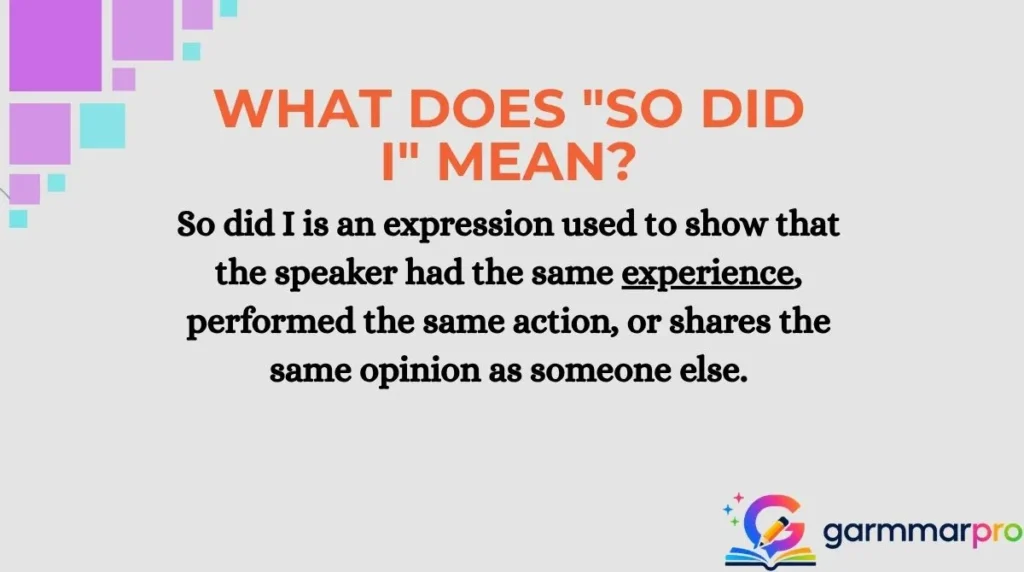
So did I is an expression used to show that the speaker had the same experience, performed the same action, or shares the same opinion as someone else.
It is a common pattern in English known as affirmative agreement.
Grammar Structure
The structure is:
So + auxiliary verb + subject
For the simple past tense:
- So + did + I
This word order is called subject–auxiliary inversion, which is also used in many English question forms. However, here it is used to express agreement rather than ask a question.
Meaning
When you say “So did I,” you’re really saying:
- I did too.
- The same thing happened to me.
- I had the same experience.
Instead of repeating the entire sentence, English speakers use this shorter structure.
Example
Person A: I watched that movie last night.
Person B: So did I.
Instead of saying:
“I watched that movie last night too.”
When to Use “So Did I”
Use so did I whenever you want to agree with a positive statement in the past tense.
Common situations include:
- Sharing experiences
- Agreeing during conversations
- Talking about completed actions
- Responding naturally in spoken English
Everyday Conversation Examples
Friend: I visited Paris last summer.
You: So did I.
Colleague: I worked late yesterday.
You: So did I.
Student: I forgot my homework.
Another student: So did I.
Neighbor: I planted tomatoes this spring.
You: So did I.
Professional Examples
Manager: I attended the client meeting yesterday.
Employee: So did I.
Supervisor: I completed the annual training.
Employee: So did I.
Academic Examples
Student A: I finished reading the novel.
Student B: So did I.
Researcher: I reviewed the latest journal article.
Colleague: So did I.
Why Native Speakers Prefer “So Did I”
Native English speakers often avoid repeating the same sentence twice.
Compare these:
✔ I went to London too.
✔ So did I.
Both are correct, but “So did I” sounds smoother and more natural in many conversations.
Common Variations
The same grammar pattern works with other auxiliary verbs.
Present Simple
- So do I.
- So does she.
Present Perfect
- So have I.
- So has he.
Past Continuous
- So was I.
- So were they.
Future
- So will I.
Modal Verbs
- So can I.
- So should we.
- So would they.
This makes so did I part of a much larger grammar pattern used throughout English.
Common Mistakes with “So Did I”
❌ I enjoyed the concert. So I did.
This sounds unnatural if your goal is agreement.
✔ I enjoyed the concert. So did I.
❌ My sister visited Rome. So I did.
Incorrect if you mean you also visited Rome.
✔ My sister visited Rome. So did I.
❌ I finished the project yesterday. So I did.
Unless you’re emphasizing or suddenly remembering that you finished it, this isn’t the natural response.
✔ I finished the project yesterday.
Another person:
So did I.
Quick Tip
Use “So did I” whenever you mean “I did too.”
If you can replace the phrase with “Me too” or “I did too,” then “So did I” is almost certainly the correct choice.
What Does “So I Did” Mean?
Unlike “So did I,” the phrase “So I did” is not primarily used to agree with another person’s statement. Instead, it is used to confirm, acknowledge, or emphasize that you performed an action—often after someone reminds you of it or when you suddenly remember it yourself.
In many conversations, “So I did” expresses realization. The speaker recognizes that something is true and confirms it.
Compare these two situations:
- Agreement: “I watched the game.” → “So did I.”
- Realization: “You watched the game yesterday.” → “Oh, so I did!”
Although the phrases contain the same words, their meanings are completely different because of the word order and the context in which they are used.
When to Use So I Did
Use so I did when you want to:
- Confirm that something is true.
- Realize or remember something.
- Emphasize that you actually performed an action.
- Respond to a reminder or correction.
- Agree with a fact about yourself rather than with another person’s similar experience.
In many cases, the phrase is preceded by words like oh, yes, actually, or indeed, which make the realization sound more natural.
Grammar Structure
The basic pattern is:
So + subject + auxiliary verb
For the simple past tense:
So + I + did
Unlike so did I, there is no inversion here. The subject comes before the auxiliary verb because this is a statement, not an agreement structure.
Meaning
So I did often means:
- You’re right—I did.
- Now that you mention it, I remember.
- Yes, I actually did that.
- I had forgotten, but you’re correct.
Everyday Conversation Examples
Friend: You left your keys on the table.
You: Oh, so I did! Thanks for reminding me.
Mother: You promised to clean your room.
Child: Oh yes, so I did.
Coworker: You already sent that email.
You: That’s right, so I did.
Friend: You met him last year.
You: Oh, so I did! I completely forgot.
Professional Examples
Manager: You approved this proposal yesterday.
Employee: So I did. Thanks for pointing that out.
Supervisor: You mentioned that during the meeting.
Employee: You’re right. So I did.
Academic Examples
Teacher: You already answered this question correctly.
Student: Oh, so I did.
Professor: You cited this study in your previous paper.
Student: Yes, so I did.
Tone and Style
“So I did” is usually:
- Conversational
- Reflective
- Slightly emphatic
- Natural in both British and American English
It is not commonly used to express agreement with another person’s experience.
Why People Confuse So I Did and So Did I
The confusion comes from three main reasons.
1. They Contain the Same Words
Both expressions use:
- so
- I
- did
Only the word order changes.
That small change creates a completely different grammatical function.
2. Both Refer to the Past
Since both use did, learners often assume they mean exactly the same thing.
They don’t.
3. Many Learners Translate Literally
In some languages, the same sentence pattern is used for both agreement and confirmation.
English separates these ideas into two different structures.
Key Differences Between So I Did and So Did I
| So I Did | So Did I |
|---|---|
| Confirms your own action | Agrees with someone else’s statement |
| Means “Yes, I did.” | Means “I did too.” |
| Statement | Agreement response |
| Subject comes first | Auxiliary comes first |
| Often expresses realization | Expresses shared experience |
| No inversion | Uses subject–auxiliary inversion |
| Less common | Extremely common |
In Simple Words
Choose So did I when:
- You also did something.
- You agree with another person’s statement.
- You share the same experience.
Choose So I did when:
- Someone reminds you about something.
- You suddenly remember doing something.
- You want to emphasize that you actually did it.
Grammar Explanation
Understanding the grammar makes the difference much easier to remember.
Subject–Auxiliary Inversion
“So did I” uses inversion.
Normal sentence:
I finished the project.
Agreement:
So did I.
Notice how did comes before I.
This inversion is required after so in affirmative agreement.
Standard Statement Order
“So I did” follows normal English word order.
Subject + Auxiliary Verb
I did
Adding so simply adds emphasis.
So I did.
No inversion is needed because it is not an agreement structure.
Parts of Speech
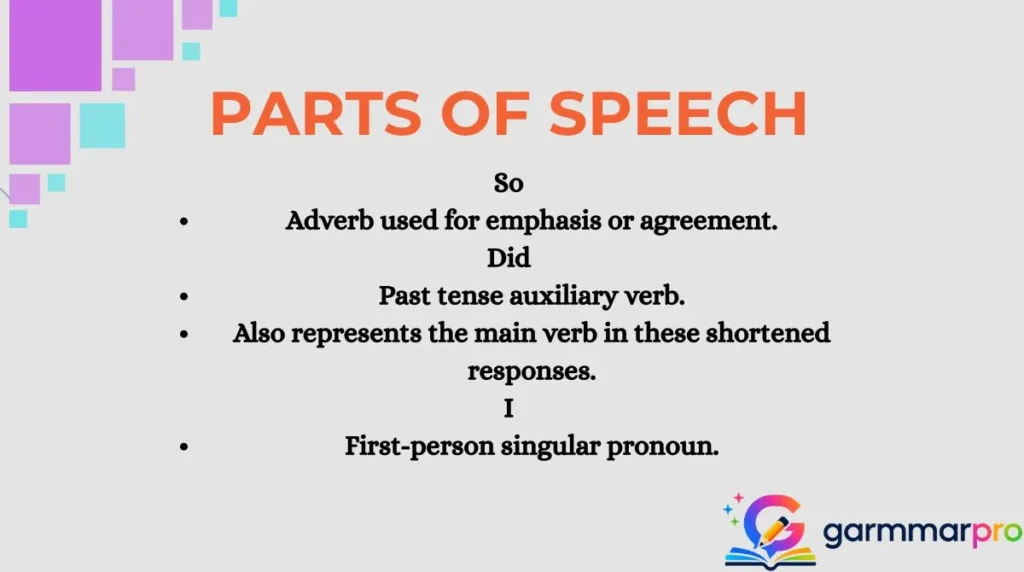
So
- Adverb used for emphasis or agreement.
Did
- Past tense auxiliary verb.
- Also represents the main verb in these shortened responses.
I
- First-person singular pronoun.
Tense
Both expressions are used with the simple past tense.
Equivalent patterns exist in other tenses.
Present:
- So do I.
- So I do.
Present Perfect:
- So have I.
- So I have.
Future:
- So will I.
- So I will.
Each pair follows the same difference between agreement and confirmation.
Real-Life Examples
Everyday Conversation
- I visited Japan last year.
So did I. - I forgot my wallet.
So did I. - You left the lights on.
Oh, so I did. - You already answered that question.
So I did. - I enjoyed the concert.
So did I.
Friends
- I saw Emma yesterday.
So did I. - You promised to help me.
So I did. - I finished the book.
So did I.
School
- I completed the assignment.
So did I. - You submitted your essay early.
So I did. - I passed the exam.
So did I.
Workplace
- I attended the meeting.
So did I. - You approved the invoice yesterday.
So I did. - I worked overtime.
So did I. - You replied to that client already.
So I did.
Manager: I reviewed your report.
Employee: So did I before sending it.
Colleague: You attached the file yesterday.
Reply: So I did. Thanks for checking.
Social Media
“I watched that documentary.”
“So did I!”
“You already liked this post.”
“Oh, so I did!”
Daily Speaking
“I called her yesterday.”
“So did I.”
“You locked the door before leaving.”
“So I did.”
“I met him at the conference.”
“So did I.”
Common Mistakes
Mistake 1: Using So I Did for Agreement
❌ I visited London.
So I did.
Why it’s wrong:
You’re trying to say you had the same experience.
✔ So did I.
Mistake 2: Using So Did I for Confirmation
❌ You forgot your umbrella.
So did I.
This means I also forgot my umbrella, not Yes, I forgot it.
If you are confirming:
✔ So I did.
Mistake 3: Mixing the Meanings
❌ You sent the email.
So did I.
Unless you’re saying you also sent an email, this changes the meaning.
If you’re confirming:
✔ So I did.
Mistake 4: Thinking They Are Interchangeable
Many learners believe both phrases have the same meaning.
They don’t.
Always ask yourself:
- Am I agreeing with someone?
- Or am I confirming something about myself?
The answer tells you which phrase to use.
Memory Tricks
Trick 1: Think “Too”
If you can say:
I did too
Use:
So did I
Example:
“I watched it.”
“So did I.”
Trick 2: Think “You’re Right”
If you can say:
“You’re right—I did.”
Use:
“So I did.”
Example:
“You forgot your keys.”
“Oh, so I did.”
Trick 3: Look at the Speaker’s Purpose
Agreement?
→ So did I.
Confirmation?
→ So I did.
Quick Summary Box
✅ So did I = I did too.
✅ So I did = Yes, I did. You’re right.
This one simple distinction will help you choose the correct phrase almost every time.
Frequently Asked Questions
Is “so did I” grammatically correct?
Yes. “So did I” is completely grammatically correct. It is the standard English structure used to show agreement with another person’s positive statement in the simple past tense.
Example:
A: I watched the football match last night.
B: So did I.
This means “I watched it too.”
Is “so I did” grammatically correct?
Yes. “So I did” is also grammatically correct, but it has a different meaning. It is used to confirm or suddenly remember that you did something.
Example:
A: You left your phone in the car.
B: Oh, so I did!
Here, the speaker is acknowledging that the statement is true.
What’s the difference between “so I did” and “so did I”?
The difference is simple:
- So did I = I did too (agreement)
- So I did = Yes, I did (confirmation or realization)
Although the words are the same, the word order changes the meaning.
Can I use “so I did” instead of “so did I”?
No. These expressions are not interchangeable.
Use “so did I” when you share someone else’s experience.
Use “so I did” when you’re confirming something about yourself after being reminded or corrected.
Which expression is more common in everyday English?
“So did I” is much more common because people frequently express agreement in conversations.
“So I did” is less common and usually appears when someone suddenly remembers or confirms an action.
Is “so did I” formal or informal?
It works well in both formal and informal English.
You’ll hear it in:
- Everyday conversations
- Business meetings
- Classroom discussions
- Interviews
- Professional presentations
It is a standard grammatical construction rather than informal slang.
Do American and British English use these phrases differently?
No. Both American English and British English use “so did I” and “so I did.”
The meanings are the same in both varieties of English.
However, “So I did!” may sound slightly more common in conversational British English when expressing sudden realization, though it is perfectly natural in American English as well.
What is the opposite of “so did I”?
To agree with a negative statement, English uses Neither did I (or Nor did I).
Example:
A: I didn’t enjoy the movie.
B: Neither did I.
Notice that So did I is only used with positive statements.
Can I say “me too” instead of “so did I”?
Often, yes.
For many informal conversations, “Me too” and “So did I” express a similar idea.
Example:
A: I visited Italy.
B: Me too.
B: So did I.
However, “So did I” sounds slightly more grammatical and polished, especially in formal spoken English and writing.
Common Grammar Patterns Related to “So Did I”
Once you understand “So did I,” you’ll recognize the same pattern across different tenses.
| Statement | Agreement |
|---|---|
| I like coffee. | So do I. |
| I can swim. | So can I. |
| I have finished. | So have I. |
| I was tired. | So was I. |
| I will join. | So will I. |
| I finished early. | So did I. |
Likewise, confirmation follows the same structure:
- So I do.
- So I can.
- So I have.
- So I was.
- So I will.
- So I did.
Recognizing these patterns will improve your overall fluency and help you respond more naturally in English.
Quick Recap
Here’s a simple way to remember the difference:
| If you mean… | Use… |
|---|---|
| I did too. | So did I. |
| You’re right—I did. | So I did. |
Ask yourself one question before choosing:
Am I agreeing with someone else’s experience, or am I confirming my own action?
The answer will point you to the correct phrase.
Final Verdict: So I Did vs So Did I
Both “so I did” and “so did I” are grammatically correct, but they serve different purposes and should not be used interchangeably.
Use “so did I” when you want to agree with someone by saying you also did the same thing. It is the standard expression for affirmative agreement in the simple past tense and is far more common in everyday conversation.
Use “so I did” when you’re confirming, emphasizing, or suddenly remembering that you performed an action. It often appears after someone reminds you of something or points out a fact about you.
If you’re ever unsure, remember this simple rule:
“So did I” = “I did too.”
“So I did” = “Yes, I did.”
Mastering this distinction will make your English sound more natural, accurate, and confident—whether you’re speaking with friends, writing emails, participating in class, or communicating in professional settings.
Key Takeaways
- Both phrases are grammatically correct.
- They are not interchangeable.
- So did I expresses agreement with another person’s positive statement.
- So I did expresses confirmation, realization, or emphasis about your own action.
- So did I is much more common in everyday English.
- Remember:
- So did I = I did too.
- So I did = You’re right—I did.
Sources and Style References
The explanations in this guide are consistent with widely accepted principles of English grammar and usage reflected in major language references and editorial standards, including:
- Cambridge Dictionary
- Oxford English Dictionary
- Merriam-Webster Dictionary
- Collins English Dictionary
- AP Stylebook (for clear, concise writing)
- The Chicago Manual of Style (for grammar and editorial conventions)
These references support the distinction between affirmative agreement (“So did I”) and confirmatory emphasis (“So I did”), which is well established in modern English usage.

Lucy Young is an English grammar educator and content writer at GarmmarPro, passionate about creating clear, engaging lessons, practical examples, and learning resources that help students improve their English with confidence.