If you’ve ever wondered whether herself, herselves, or her self is correct, you’re not alone. These forms often confuse English learners and even native speakers because they look similar but follow different grammar rules.
The confusion usually comes from misunderstanding reflexive pronouns and the difference between modern English and older writing styles.
While one form is standard English, another is generally considered incorrect, and the third appears only in limited historical or stylistic contexts.
Knowing which form to use matters whether you’re writing an email, an academic paper, a business document, or simply chatting with friends. Using the wrong form can make your writing look ungrammatical or outdated.
In this guide, you’ll learn the differences between herself, herselves, and her self, when each form is appropriate, why people confuse them, and how to avoid common mistakes.
Quick Answer
- Herself is the correct reflexive pronoun and is the form you should use in modern English.
- Herselves is not a standard English word and should almost always be avoided.
- Her self (written as two words) is an older or highly specialized form that occasionally appears in historical texts but is rarely used in contemporary English.
For almost every situation, choose herself.
Herself vs. Herselves vs. Her Self: Comparison Table
| Feature | Herself | Herselves | Her Self |
|---|---|---|---|
| Correct in modern English | ✅ Yes | ❌ No | ⚠ Rarely |
| Part of speech | Reflexive pronoun | Nonstandard form | Noun phrase (historical/stylistic) |
| Used in everyday writing | ✅ Yes | ❌ No | ❌ Rarely |
| Used in academic writing | ✅ Yes | ❌ No | Rare except when quoting |
| Used in business writing | ✅ Yes | ❌ Never | ❌ Avoid |
| Found in dictionaries | ✅ Yes | ❌ No | Mentioned as historical usage |
| Sounds natural today | ✅ Yes | ❌ No | Usually no |
| Common mistake | Sometimes omitted | Incorrect pluralization | Incorrect spacing |
| Best choice | ✅ Always in normal contexts | Avoid | Only for historical or literary contexts |
What Is Herself?
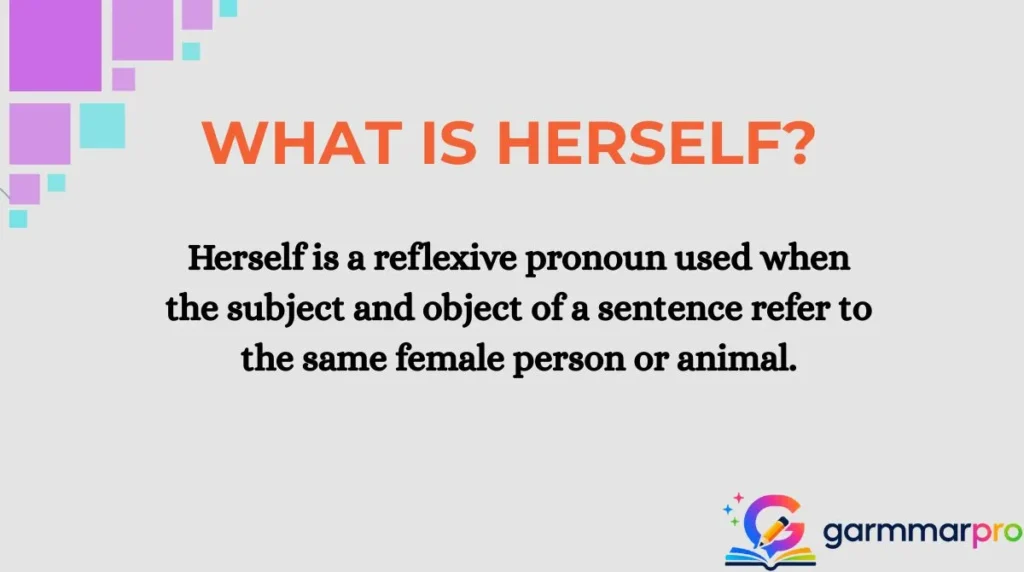
Herself is a reflexive pronoun used when the subject and object of a sentence refer to the same female person or animal.
It can also be used for emphasis, drawing attention to the person performing an action.
Definition
Herself refers back to a previously mentioned female subject.
Examples:
- Sarah introduced herself.
- Emily blamed herself for the mistake.
- The queen herself attended the ceremony.
- She prepared the presentation herself.
Pronunciation of Herself
IPA (UK): /həˈself/
IPA (US): /hɝˈself/
Pronounced as:
her-SELF
The stress falls on the second syllable.
Grammar of Herself
Herself belongs to the family of reflexive pronouns, including:
- myself
- yourself
- himself
- herself
- itself
- ourselves
- yourselves
- themselves
These pronouns are used when the subject performs an action on itself or to emphasize the subject.
For example:
✔ She looked at herself in the mirror.
Here, “she” and “herself” refer to the same person.
When to Use Herself
1. As a Reflexive Pronoun
Use herself when the action returns to the subject.
Examples:
- She hurt herself.
- Maria taught herself French.
- Emma reminded herself to call her mother.
- The actress prepared herself for the role.
2. For Emphasis
Herself can emphasize that someone personally did something.
Examples:
- The CEO herself signed the agreement.
- The author herself answered readers’ questions.
- She completed the project herself.
- My grandmother herself baked the cake.
3. In Professional Writing
Business English frequently uses herself correctly.
Examples:
- The manager introduced herself to the new employees.
- The director herself approved the proposal.
- She assigned herself the most challenging task.
4. In Academic Writing
Examples:
- The researcher described herself as an independent investigator.
- The participant identified herself in the interview.
5. In Everyday Conversation
Examples:
- She bought the dress herself.
- Lily made dinner by herself.
- She can take care of herself.
- Anna kept the surprise to herself.
Common Expressions with Herself
You’ll often see herself in these natural expressions:
- by herself
- all by herself
- keep to herself
- help herself
- introduce herself
- enjoy herself
- express herself
- defend herself
- prepare herself
- blame herself
Examples:
- She lives by herself.
- Please help yourself to some coffee. (Different pronoun, same pattern.)
- She enjoyed herself at the party.
- She kept the news to herself.
Origin of Herself
The word herself developed from Middle English combinations of her and self. Over time, English standardized the spelling into the single-word reflexive pronoun we use today.
Modern dictionaries—including Merriam-Webster, Cambridge Dictionary, Oxford English Dictionary, and Collins Dictionary—recognize herself as the standard form.
Style guides such as the AP Stylebook and The Chicago Manual of Style also treat herself as the correct modern usage.
Common Mistakes with Herself
Even though herself is straightforward, writers sometimes misuse it.
Incorrect:
❌ Sarah and herself went shopping.
Correct:
✔ Sarah and she went shopping.
or
✔ Sarah went shopping by herself.
Incorrect:
❌ Please give the report to myself or herself.
Correct:
✔ Please give the report to her.
Why? Reflexive pronouns should generally refer back to the subject of the same clause. They should not replace ordinary object pronouns such as me, him, or her.
Tips for Using Herself Correctly
- Use herself only when referring back to the same female subject.
- Don’t replace her with herself unless grammar requires a reflexive pronoun.
- Use herself for emphasis only when the sentence still makes sense without it.
- In modern English, herself is almost always the correct choice over her self.
What Is Herselves?
Herselves is not a standard English word. It is commonly assumed to be the plural form of herself, but English does not form reflexive pronouns this way.
Instead, the correct plural reflexive pronouns are based on the subject:
- ourselves
- yourselves
- themselves
There is no accepted reflexive pronoun spelled herselves in standard English.
Is Herselves Ever Correct?
In modern standard English, no.
Major dictionaries, grammar references, and style guides do not recognize herselves as a standard word.
You may occasionally encounter it in:
- typing mistakes
- learner errors
- informal online posts
- fictional dialogue representing incorrect speech
These are exceptions rather than correct usage.
Why Do People Write Herselves?
People usually create herselves by applying a logical—but incorrect—pattern.
They think:
- herself → plural = herselves
However, English uses:
- she → themselves (when referring to multiple women)
- herself → themselves for plural subjects
Examples:
❌ The girls prepared herselves.
✔ The girls prepared themselves.
Examples of Incorrect Usage
Incorrect:
- She blamed herselves.
- The sisters introduced herselves.
- The women defended herselves.
- They looked at herselves in the mirror.
Correct:
- She blamed herself.
- The sisters introduced themselves.
- The women defended themselves.
- They looked at themselves in the mirror.
Why You Should Avoid Herselves
Using herselves may:
- Make your writing appear grammatically incorrect.
- Confuse readers.
- Reduce credibility in academic and professional writing.
- Be flagged by grammar checkers and editors.
For polished English, avoid herselves entirely. In the next part, we’ll examine her self—why it appears in older texts, when (if ever) it’s appropriate today, and how it differs from herself.
What Is Her Self?
At first glance, her self may seem like a misspelling of herself, but the two forms are not always identical. In modern English, herself (one word) is the standard reflexive pronoun. Her self (two words) survives mainly in historical writing, literary works, and a few specialized contexts where self functions as a noun rather than part of a pronoun.
For everyday writing, emails, school assignments, business communication, and academic work, you should almost always write herself as one word.
Definition of Her Self
Her self is a noun phrase consisting of:
- her (a possessive determiner)
- self (a noun)
Historically, English writers often wrote reflexive forms as two separate words before spelling became standardized. Over time, forms such as my self, him self, and her self evolved into the single-word reflexive pronouns myself, himself, and herself.
Today, her self is uncommon and usually appears only:
- in quotations from older texts
- in discussions of language history
- when self is deliberately treated as a separate noun
Pronunciation of Her Self
When used as two words, it is generally pronounced the same as herself:
IPA (UK): /hə ˈself/
IPA (US): /hɝ ˈself/
The pronunciation does not usually help distinguish the two forms. The difference is grammatical and stylistic rather than phonetic.
When Can Her Self Be Used?
Although rare, her self may be appropriate in a few situations.
1. In Historical Texts
Older English literature sometimes uses two-word reflexive forms.
Example:
She kept her self apart from the crowd.
Modern English would normally write:
She kept herself apart from the crowd.
2. When Discussing Identity or the Concept of the Self
Sometimes self is used as an independent noun.
Examples:
- She struggled to understand her self after the experience.
- The novel explores her self as a changing identity.
These examples are uncommon. Many editors would still prefer herself or would rewrite the sentence for greater clarity.
3. In Linguistic or Historical Discussions
Language historians may refer to earlier spellings.
Example:
Early Modern English frequently used forms such as her self before the modern spelling became standard.
Should You Use Her Self Today?
For almost all modern writing, no.
Choose herself instead.
Use her self only when:
- quoting historical material
- analyzing language history
- preserving the original spelling of an older document
Why Do People Confuse These Forms?
There are several reasons.
Similar Appearance
Since herself contains the word self, some writers naturally separate it into two words.
However, English has standardized the spelling.
Correct:
- herself
Incorrect for modern English:
- her self
Older Books and Documents
Readers sometimes encounter her self in older literature and assume it remains acceptable today.
Modern English no longer treats it as the preferred spelling.
Confusion with Other Compound Words
English contains many words that can be open, hyphenated, or closed compounds.
Examples include:
- everyday / every day
- sometime / some time
- anyone / any one
Some learners mistakenly believe herself follows the same flexible pattern, but it does not.
Key Differences Between Herself, Herselves, and Her Self
- Herself is the standard modern reflexive pronoun.
- Herselves is not accepted in standard English.
- Her self is an older or specialized form rarely used today.
- Dictionaries recognize herself as the standard spelling.
- Professional editors replace her self with herself unless preserving historical text.
- Grammar checkers usually flag herselves as an error.
- In modern English, herself is the safest and most natural choice.
Grammar Explanation
Understanding why only one form is correct becomes much easier once you know how reflexive pronouns work.
Part of Speech
Herself is a reflexive pronoun.
Example:
- She introduced herself.
It refers back to the subject (she).
Reflexive Pronouns in English
| Subject Pronoun | Reflexive Pronoun |
|---|---|
| I | myself |
| You | yourself |
| He | himself |
| She | herself |
| It | itself |
| We | ourselves |
| You (plural) | yourselves |
| They | themselves |
Notice that there is no reflexive pronoun called herselves.
Singular vs. Plural
Singular:
- She congratulated herself.
Plural:
- They congratulated themselves.
Incorrect:
- They congratulated herselves.
Possessive vs. Reflexive
Compare these examples:
Possessive:
- Her book is on the desk.
Reflexive:
- She bought the book for herself.
The possessive adjective her cannot replace the reflexive pronoun herself.
Sentence Position
A reflexive pronoun usually follows the verb or a preposition.
Examples:
- She blamed herself.
- She spoke to herself.
- She looked at herself.
- She kept the secret to herself.
Style Guide Recommendations
Major English style guides and dictionaries consistently recommend herself in modern writing.
These include:
- AP Stylebook
- The Chicago Manual of Style
- Oxford English Dictionary
- Cambridge Dictionary
- Merriam-Webster
- Collins Dictionary
None recommend herselves as standard English.
Real-Life Examples
Below are original examples showing correct and incorrect usage across different contexts.
Everyday Conversation
✔ She cooked dinner herself.
✔ Emma bought the gift herself.
✔ She looked at herself in the mirror.
✔ She kept the surprise to herself.
School
✔ Sarah introduced herself to the class.
✔ The student challenged herself to improve her grades.
✔ She prepared herself for the exam.
Business
✔ The manager herself welcomed the new employees.
✔ She assigned herself the difficult project.
✔ The director introduced herself before the meeting began.
Academic Writing
✔ The researcher described herself in the methodology section.
✔ The participant identified herself during the interview.
✔ She introduced herself in the first paragraph of the email.
✔ The applicant presented herself professionally.
Social Media
✔ She filmed the entire video herself.
✔ She challenged herself to post every day for a month.
Text Messages
✔ I’ll ask her to call you. (Not “herself.”)
✔ She’ll explain everything herself.
Daily Speaking
✔ She can take care of herself.
✔ She fixed the problem herself.
✔ She reminded herself to lock the door.
✔ She believes in herself.
✔ She enjoyed herself on vacation.
✔ She introduced herself with confidence.
These examples show that herself fits naturally in every type of modern communication, while herselves and her self do not.
Common Mistakes
Mistake 1: Using Herselves as a Plural
❌ The girls blamed herselves.
Why it’s wrong: English uses themselves for plural subjects.
✔ The girls blamed themselves.
Mistake 2: Writing Her Self in Modern English
❌ She introduced her self.
Why it’s wrong: Modern English treats herself as one word.
✔ She introduced herself.
Mistake 3: Using Herself Instead of Her
❌ Please give the package to herself.
Why it’s wrong: The sentence needs the object pronoun her, not a reflexive pronoun.
✔ Please give the package to her.
Mistake 4: Using a Reflexive Pronoun Without a Matching Subject
❌ John spoke to herself.
Why it’s wrong: The subject is John, so the reflexive pronoun must match.
✔ John spoke to himself.
Mistake 5: Using Herself for Emphasis Incorrectly
❌ Myself and herself completed the report.
Why it’s wrong: Reflexive pronouns should not replace ordinary subject pronouns.
✔ She and I completed the report.
Memory Tricks
Trick 1: Think of the Reflexive Pronoun Family
If you remember:
- myself
- yourself
- himself
- herself
- ourselves
- yourselves
- themselves
you’ll notice there is no herselves.
Trick 2: One Woman = Herself
If the subject is she, use herself.
Example:
- She congratulated herself.
Trick 3: Many Women = Themselves
If the subject is plural, use themselves, not herselves.
Example:
- The women congratulated themselves.
Trick 4: One Word Wins
Modern English writes the reflexive pronoun as one word:
✔ herself
Not:
❌ her self.
Frequently Asked Questions
Is herself or herselves correct?
Herself is the correct word in standard English when referring to one female person. Herselves is not a standard English word and should be avoided.
Example:
- ✔ She introduced herself.
- ❌ She introduced herselves.
Is her self the same as herself?
Not exactly.
In modern English, herself is the standard spelling. Her self is an older or highly specialized form that may appear in historical or literary texts, but it is not recommended for everyday writing.
Modern usage:
- ✔ She blamed herself.
Historical usage:
- She blamed her self. (Found in older texts.)
Why isn’t herselves the plural of herself?
English reflexive pronouns do not form plurals by simply adding -s.
The correct plural reflexive pronoun is themselves.
Examples:
- ✔ She prepared herself.
- ✔ The women prepared themselves.
- ❌ The women prepared herselves.
Is her self grammatically wrong?
In most modern writing, yes.
Although her self has historical roots, today’s English uses herself as the standard reflexive pronoun. Unless you’re quoting an old text or discussing language history, choose herself.
Do dictionaries recognize herselves?
No.
Major dictionaries, including Oxford, Cambridge, Merriam-Webster, and Collins, recognize herself as the standard reflexive pronoun. Herselves is not listed as a standard English word.
Which form should I use in academic or business writing?
Always use herself.
Professional editors, teachers, universities, and style guides expect the standard form.
Examples:
- ✔ The researcher introduced herself.
- ✔ The manager prepared herself for the presentation.
Can I write her self in creative writing?
Yes, but only if there is a clear reason.
For example, you might preserve historical spelling in a novel, quote an older document, or intentionally use self as a separate noun. Otherwise, herself is the preferred choice.
Is herself a reflexive pronoun or an intensive pronoun?
It can be both, depending on how it is used.
Reflexive pronoun:
- She blamed herself.
The action refers back to the subject.
Intensive pronoun:
- The CEO herself announced the decision.
Here, herself simply emphasizes the subject.
People Also Ask
Which is correct: herself, herselves, or her self?
Herself is the correct choice in modern English. Herselves is grammatically incorrect, and her self is an outdated or highly specialized spelling.
Is herselves ever acceptable?
Not in standard English. It may appear as a typo, in learner writing, or in dialogue that intentionally reflects incorrect speech, but it should not be used in formal or everyday writing.
Why do people write her self as two words?
This usually happens because:
- they separate the compound word by mistake,
- they have seen the historical spelling in older books, or
- they are unfamiliar with modern reflexive pronouns.
Today, herself is the accepted spelling.
What is the plural of herself?
There is no direct plural form of herself.
Instead, English uses themselves for plural subjects.
- ✔ She enjoyed herself.
- ✔ The girls enjoyed themselves.
Is herself one word or two?
It is one word.
Write:
✔ herself
Not:
❌ her self
Can herself be used for emphasis?
Yes.
In this use, it is called an intensive pronoun.
Examples:
- The author herself signed every copy.
- The teacher herself answered the question.
Removing herself does not change the basic meaning of the sentence, but it removes the emphasis.
Quick Summary
| Word | Modern English | Recommendation |
|---|---|---|
| Herself | ✅ Correct | Use in all normal writing |
| Herselves | ❌ Incorrect | Avoid completely |
| Her self | ⚠ Historical/Rare | Use only in quotations or discussions of older English |
Final Verdict: Herself vs. Herselves vs. Her Self
If you’re deciding between herself, herselves, and her self, the answer is straightforward:
- Use herself for modern English. It is the standard reflexive and intensive pronoun recognized by dictionaries, grammar references, and major style guides.
- Avoid herselves. It is not a standard English word and is considered a grammatical error in almost every context.
- Use her self only in exceptional cases, such as quoting historical texts or discussing the evolution of English spelling.
For everyday conversations, academic papers, business documents, emails, and professional writing, herself is the only form you should normally use.
Whether you’re preparing for an English exam, improving your writing skills, or editing professional content, choosing the correct form helps your writing sound clear, natural, and grammatically accurate.
Key Takeaways
- ✅ Herself is the correct modern English form.
- ❌ Herselves is not accepted in standard English.
- ⚠ Her self is an older spelling that survives mainly in historical or linguistic contexts.
- ✅ Use herself in school, business, academic, and everyday writing.
- ✅ For plural subjects, use themselves, not herselves.
Related Grammar Topics
- Himself vs. Him Self
- Myself vs. My Self
- Yourself vs. Your Self
- Themselves vs. Theirselves
- Reflexive Pronouns in English
- Intensive Pronouns Explained
- Common English Grammar Mistakes
- Singular and Plural Pronouns
- Subject and Object Pronouns
- English Pronoun Rules for Learners

Lucy Young is an English grammar educator and content writer at GarmmarPro, passionate about creating clear, engaging lessons, practical examples, and learning resources that help students improve their English with confidence.